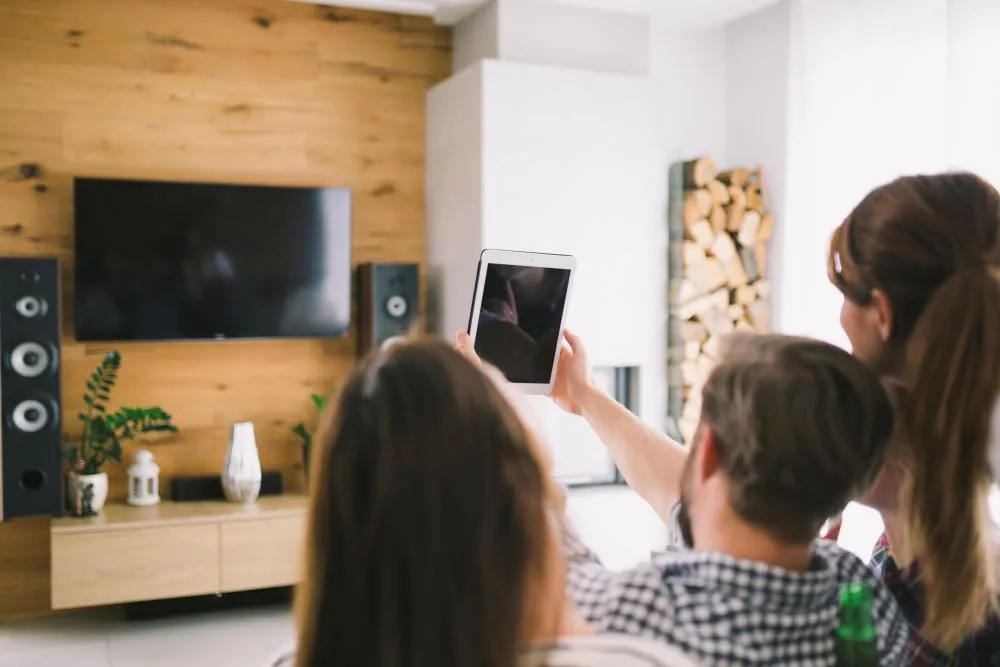

A home theatre AV system can turn your living area into a cinematic oasis. However, if you plunge in without proper forethought and planning, you may run into hiccups, some costly issues, and you will likely be disappointed with the outcome you get.
With home theatres expected to reach an industry value of $19.98 billion by 2030, a growing number of homeowners are leaping into this world of entertainment. But most, far too many, miss critical setup essentials that distinguish an average system from a fantastic one.
Regardless of whether you are a total novice or someone who just wants to upgrade their current AV system, grasping essential facets prior to purchase will save you time, money, and hassle while establishing your optimal all-encompassing ambience experience.
Dimensions And Acoustics of Your Room
Your room is the most critical aspect of your home theatre system and one thing you can’t replace. The dimensions, materials used, and space layout will affect how sound moves through your room, as well as the performance of your system.
The ideal proportions of a room are represented as having particular ratios that are less likely to lead to acoustical problems. Although you may not be able to incorporate them into an existing home, a room with a height-to-width-to-length ratio of 1:1.6:2.6 or 1:1.4:1.9 will provide superior sound quality by minimising standing waves and room resonances as fractions of the wavelength compared to a space with ratios like 1:3:5.
You may be tempted by hard surfaces, such as uncovered walls or tiled floors, or glass windows, which will essentially create a sound reflection that will muddle your dialogue and distort music. Or you can cut to the chase by taking help from Richmond AV, an AV professional who can help with the assessment of room dimensions and acoustic demands.
Easy Acoustic Treatments That Make a Better Space
You do not need to go get professional acoustic panels to improve the sound in your room. Think soft! Large house plants, heavy curtains, area rugs, tapestries, wall hangings, and anything else to cover surfaces can help with unwanted reflections.
First reflection points refer to the instances where the sound produced by your speakers reflects off the wall before arriving at your ears. To help control early first reflections for audio clarity, consider placing absorption panels on that wall directly behind your screen. If you would like to figure out these locations, consider having someone move a mirror along that wall while you are sitting in your listening position. Wherever you see the speaker in the mirror is a first reflection spot.
The strategy for furniture placement matters more than most people realise. Natural items such as bookshelves, couches, and other furniture break up sound waves and lessen echo. Try to position larger pieces of furniture further away from any direct line to your speakers, and don’t place your seating directly against the back wall, where most of the bass will build up.
The AV Receiver Is The Command Centre
The AV receiver is the mission control centre for your entire home theatre system. It processes video, amplifies audio, and routes signals to multiple speakers and displays. This one component is responsible for a great deal of the capability of your system and for expandable capabilities into the future.
Power output considerations require matching the receiver’s power capabilities to the speakers. While peak power ratings are often advertised by manufacturers, rely on continuous power ratings based on your speakers’ impedance.
The channel configuration planning begins with understanding the numbering system. A 5.1 includes five speakers (left, right, centre, left surround, right surround) and one subwoofer. The continuing trend of 7.1 systems adds two more surround channels. Lastly, consider your needs versus your future needs, as you will want the ability to expand. A 7.2-channel receiver allows for secure expansion even if you simply start with a stereo configuration.
The Speaker Selection
The first major decision point is passive against active speakers. Passive speakers need to be powered by your AV receiver, giving you more flexibility and generally better performance for the money. Active speakers have built-in amplifiers, making them easier to set up but limiting your upgrade potential in the future.
Speaker types go from stereo to full-blown multi-channel. A penny saved is often a penny lost when it comes to speaker selection. The three tightly matched speakers in a 3.1 setup will typically sound better than five budget speakers in a 5.1 configuration. Buy the best left, right, and centre speakers you can afford and upgrade with surrounds and overheads later.
Display Considerations
Your display will dictate the overall layout of your room, so it’s worth considering how you’re going to set it up and how it’s going to limit your viewing experience. As with screens, for TVs you need to calculate your screen size considering your viewing distance; sitting too close to a screen that’s too big can create eye strain, too small will ruin immersion.
To calculate the correct screen size for a TV, take your viewing distance (in inches) and multiply it by .6 to give you the recommended screen size, which is around the maximum you should go. If your viewing distance is 120 inches, then 72 inches is probably the maximum to go. However, you may adjust this depending on personal preferences or the types of content you’re watching.
Video quality is defined more by resolution and HDR functionality than the actual size of a screen. A 4K screen can deliver an unprecedented level of sharpness, which becomes evident within the normal viewing distance of the average user. HDR (High Dynamic Range) enhances colour accuracy and contrast to a degree that cannot be explained. Further, you must know that how AV system is changing the environment of the modern lifestyle.
Proper Speaker Placement Fundamentals
Basic speaker positioning guidelines work for any room type with space for the left and right main speakers to create an equilateral triangle with the listener. Most room types have left and right main speakers spaced 6–8 feet apart.
The centre channel speaker should be positioned to centre on-screen, as closely as possible, at the same level as the left and right speakers. If the centre channel is positioned above or below the screen, angling toward the listening position produces the clearest sound for dialogue.
Speaker positioning for surround sound systems varies by system type. In a 5.1 system, surround speakers are placed at 90–110 degrees from the listening position, slightly behind and above ear level. In a 7.1 system, side surrounds would be positioned at 90 degrees and 135–150 degrees for rear surrounds.
To find the best subwoofer placement for your space, trial and error is required because bass interacts differently with room boundaries. Begin by positioning it in a corner, in front of your room, and then try different positions while listening to bass-heavy music you know well. Attempt the “subwoofer crawl,” where you place the sub at your main listening position and walk all around the room, listening to find where the bass sounds most smooth.
Calibration and Fine Tuning
If an automatic room correction system (Audyssey, Dirac Live, YPAO, etc.) is available, use it. These systems can analyse your room and its acoustic restrictions to adjust your receiver settings. Each system will provide instructions for the next steps in its calibration process.
These systems should measure the distance from speakers to the calibration microphone, identify crossover frequencies, and even apply equalisation as necessary for a smoother frequency response in your space.
Run your room correction system multiple times, and listen each time, because you will get different results based on microphone placement. Set the calibration microphone at the ear level of your main listening position and follow whatever instructions are given by your receiver.
Your room correction goes a long way to expose your room corrections, given that it adjusts settings, but a lot can be done manually as well.
Ideally, you would use the adjusted settings from the automatic room correction system as a starting point, and then make small adjustments (e.g., speaker level, crossover frequency, delay time) as needed to enhance the listening experience.
Listen to a wide range of content that is familiar to you, because dialogue-heavy scenes, music recordings, and action sequences stress different aspects of your system. Listen and adjust, making small changes from one listening session to another, to assess your improvement in the setup, not the differences just installing scalable AV system.
When to Call the Experts
In-wall wiring, speakers on the ceiling, and automation systems throughout the house are complicated installations that professionals should complete. They have the tools and experience necessary to comply with building codes, as well as installer warranties for their work.
Even fairly simply constructed rooms that might also double as dedicated theatre rooms require coordination between many trades, electricians, carpenters, acousticians, and the right AV system specialists to build the room to code and ensure that everything works together and meets your expectations.
Engaging professionals with commercial services can save you money and allow for proper integration. Richmond AV is the best choice if you’re looking for a true professional to design and install AV systems or home theatres inside a residential home.
Conclusion
Building an experience for your home theatre that is truly gratifying requires you to weigh technical knowledge, practicalities, and the particularities of your wants. Never forget: an enjoyable home theatre system is one that you love using time and time again for many years.
Focus on a solution true to your content ingestion characteristics, boundaries of the room, and your eventual upgrade schedule, rather than specifications being copied if you happen to hear someone else’s home theatre room configuration and go that route.